The Banana Bread Experiment - by Meghan Fitzgerald - a10d

The Banana Bread Experiment
A simple twist that changed how we and our kids think about using AI


It started with three overripe bananas and two parents who were too busy to help our 11 year old make banana bread.
Instead of searching the internet for a recipe to follow, we encouraged her to try something different. Ask Claude, “What are all of the questions I’d need to answer in order to make delicious banana bread?”
And so she did.
Rather than steps to follow, Claude offered a series of questions.
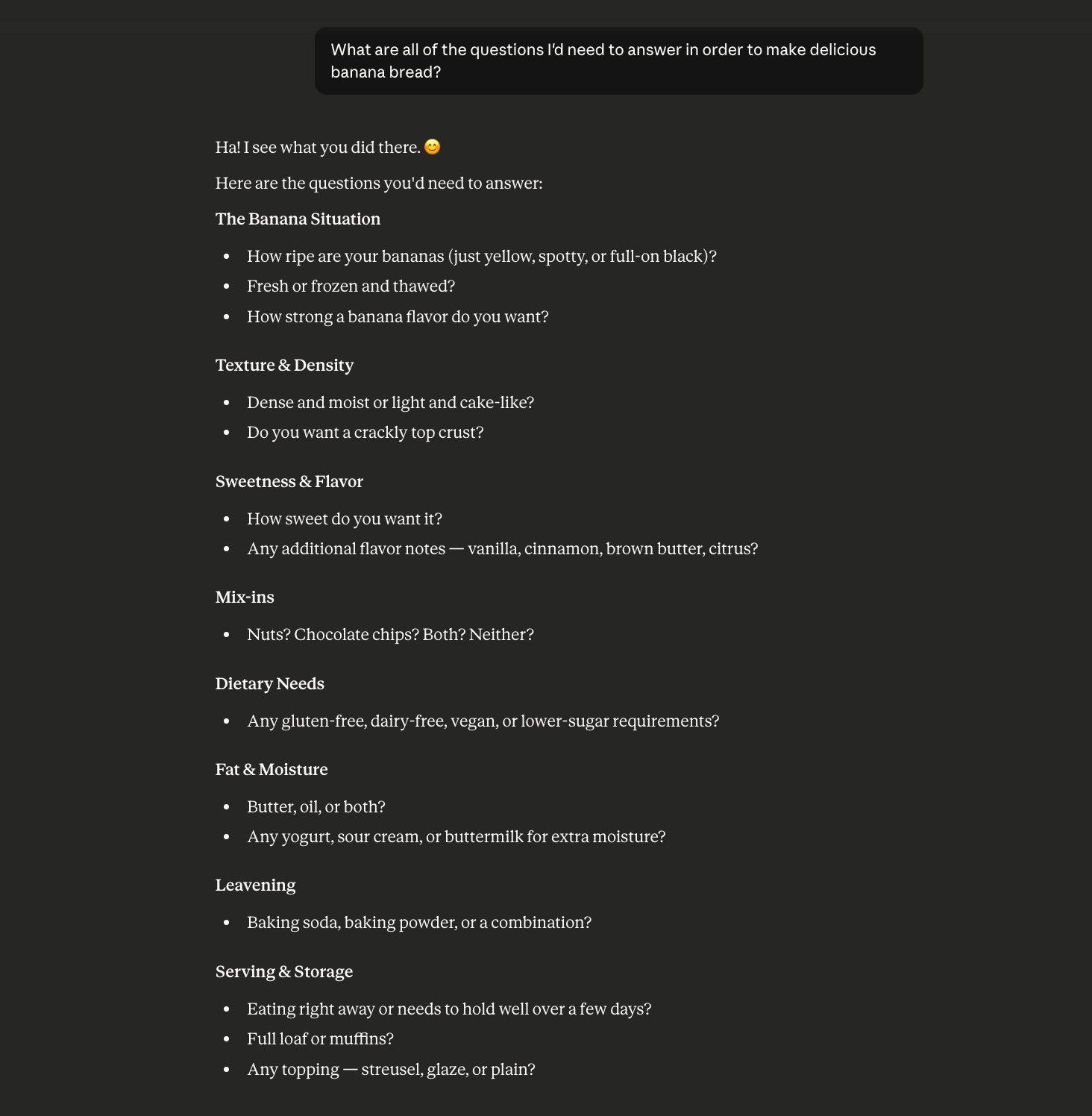
At first, she was a little stymied by the long list. But once she realized she just needed to respond with her preferences, something shifted. It was as if she was genuinely stoked to be asked what she thought. After she answered everything, Claude generated a recipe that felt custom-built for her.
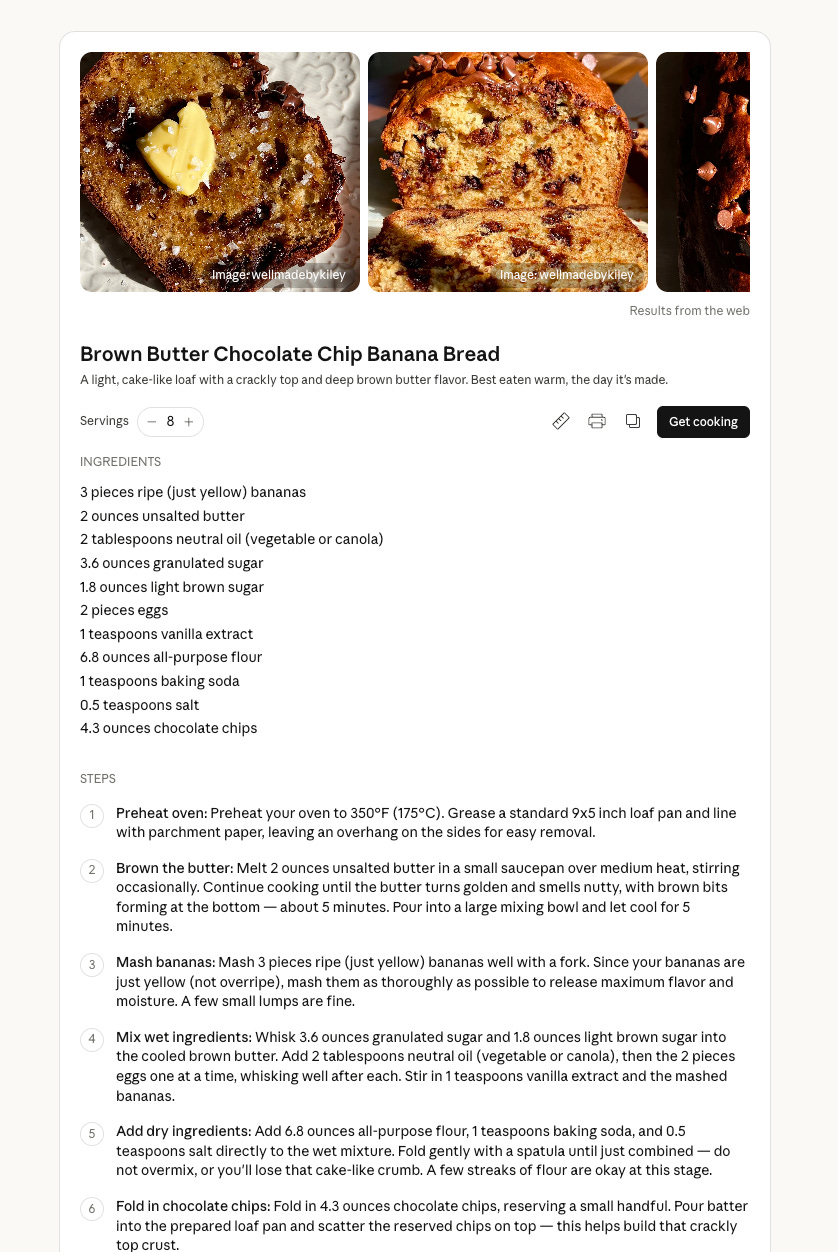
She seemed delighted and hell bent on hitting the kitchen, eager to see if it actually matched the preferences she’d established. We did grumble a bit over having to convert all of Claude’s esoteric measurements (e.g. 3.6 ounces?!). That is, until our oldest reminded us that we could ask Claude to re-generate the recipe using only cups, tablespoons and teaspoons (and, voila!). Most of all, we were all glad to see how invested our youngest was in making “her” banana bread.
Overall, the banana bread delivered. But, we were pleased to see that she retained a critical eye noting, “the top could have been a bit more crackly.”
How we got the idea
For a while now, my husband and I have been wrestling with a gnawing tension related to AI and kids’ learning. I remember talking about a 2025 OpEd in the NY Times by David Brooks that warned, AI is making us dumber. Brooks cited an MIT study that found using AI for essay writing diminished the learning value compared to researching and summarizing for yourself. And yet, so many kids we knew were using AI for support in completing learning tasks.
Immediately, the results felt intuitive. Those of us on Team Human (shout out Doug Rushkoff!) felt affirmed, and I’m pretty sure the English major deep inside me wanted all of those hours spent reading, annotating and summarizing to be worth it.
But, as we talked it out, the questions that kept surfacing were: What might be missing in how kids are using AI? And is there a better way? Perhaps one that preserves engagement and actually enhances learning?
We haven’t fully answered those questions. But we keep circling back to the power of curiosity and inquiry as a supertool. What if, instead of asking AI for answers, we used it to fuel our questions? Maybe even make us better at questioning (the heart of all learning)?
The banana bread experiment was a small but sweet test of that concept.
How to try it
The next time your kid wants to make something, do something, or figure something out, consider inviting them to start by generating questions.
Pull up your LLM (Large Language Model) of choice (e.g. Claude.ai or ChatGPT) and help your kiddo craft a prompt that, instead of asking for steps to follow, asks “Can you help me think of a list of questions I’d need to answer in order to ____.”
To add even more value, encourage kids to generate 2-3 more questions on their own or with the help of a sibling, neighbor or family member.
Support them as needed. Then check in: How did this process feel compared to times they’ve looked to other sources or just asked AI for an answer?
What we found
Our 11 year old got deeply into the process and the recipe itself, both ingredients and steps. She scrutinized the components, wondering whether Claude had actually honored her preferences. Post tasting, she even pushed back on Claude and wondered, “what could I have done to make the top more crusty?” That scrutiny sure feels like engaged learning.
Also great to see, she’s repeated this on her own, unprompted, across a few different projects: how to crochet a rose; how to write a limerick; how to trap a leprechaun; and how to do something kind for my 92-year-old neighbor.
My husband and I have also found ourselves using the same tactic on tasks that feel daunting or just plain boring to us. Starting a project by generating questions does something small but real: it boosts engagement, preserves agency, and shifts AI from a dumbing-down answer oracle into something more like a curiosity-stoking guide.
Why it matters
When we are supporting learning, and especially learning for adolescents, we increasingly think about learner agency — the felt sense that your choices matter and lead somewhere, that you are the author of your own actions. It’s one of the core things we believe kids need most right now, and one of the things most at risk in a world where frictionless answers are only one prompt away—and agents asking each other the answer is just another half step from there.
This simple twist doesn’t solve everything. But it’s a tangible way to put kids in the driver’s seat, boost their inquiry muscles and use AI as a thinking partner rather than a thinking replacement.
Three overripe bananas. One small question. Turns out, that’s enough to bake bread!
Try it this week!
Next time your kid faces a how-to challenge, invite them to ask their AI: “What questions would I need to answer in order to ____?” And what follow up questions do they raise after they get a response? Then let us know what happens.
Uncertain?
If this feels like uncharted territory for kids or for you, consider co-piloting with your kiddo and playing the role of curious thought partner the next time they want to figure something out. One great way to do that? Follow the steps above, side by side, and process each step along the way—together. Or, remove the AI component altogether, and just get in the business of generating questions as a first step to create, learn or do something new. Inquiry and curiosity are super tools kids need en force to navigate the world we’re evolving into!


